








1909 Indian 5 HP Light Twin
Inventory Number: 5053
$125,000
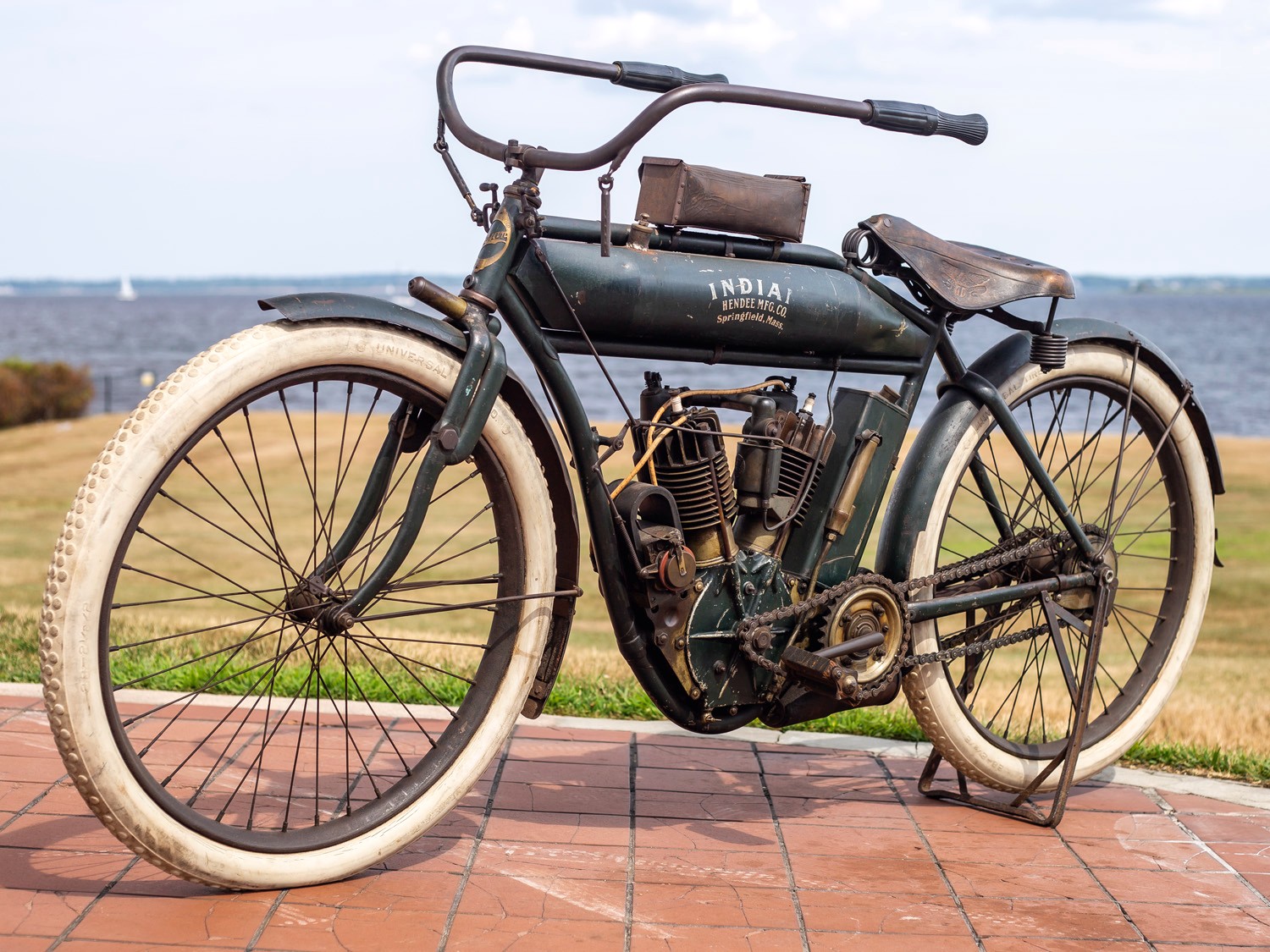
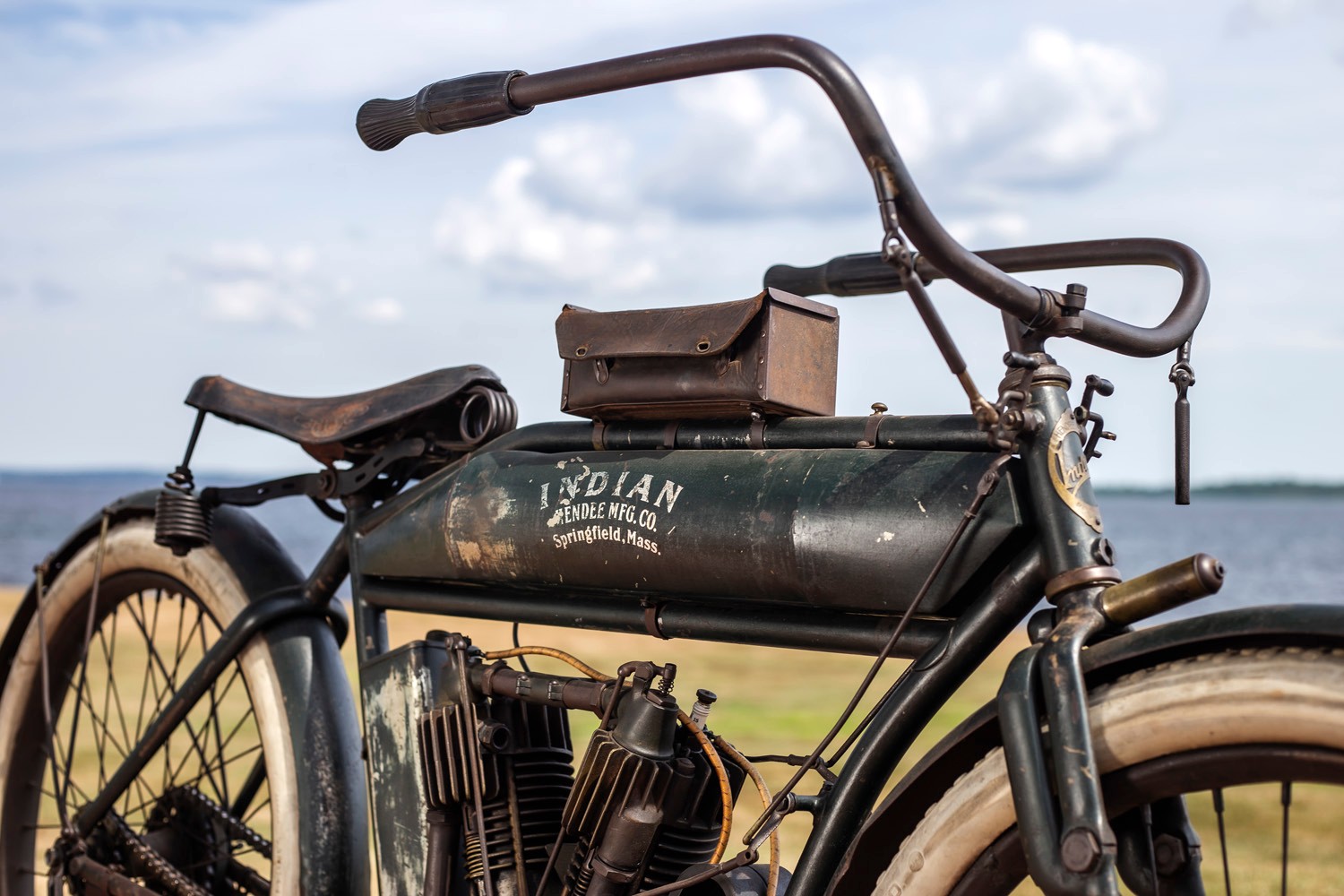
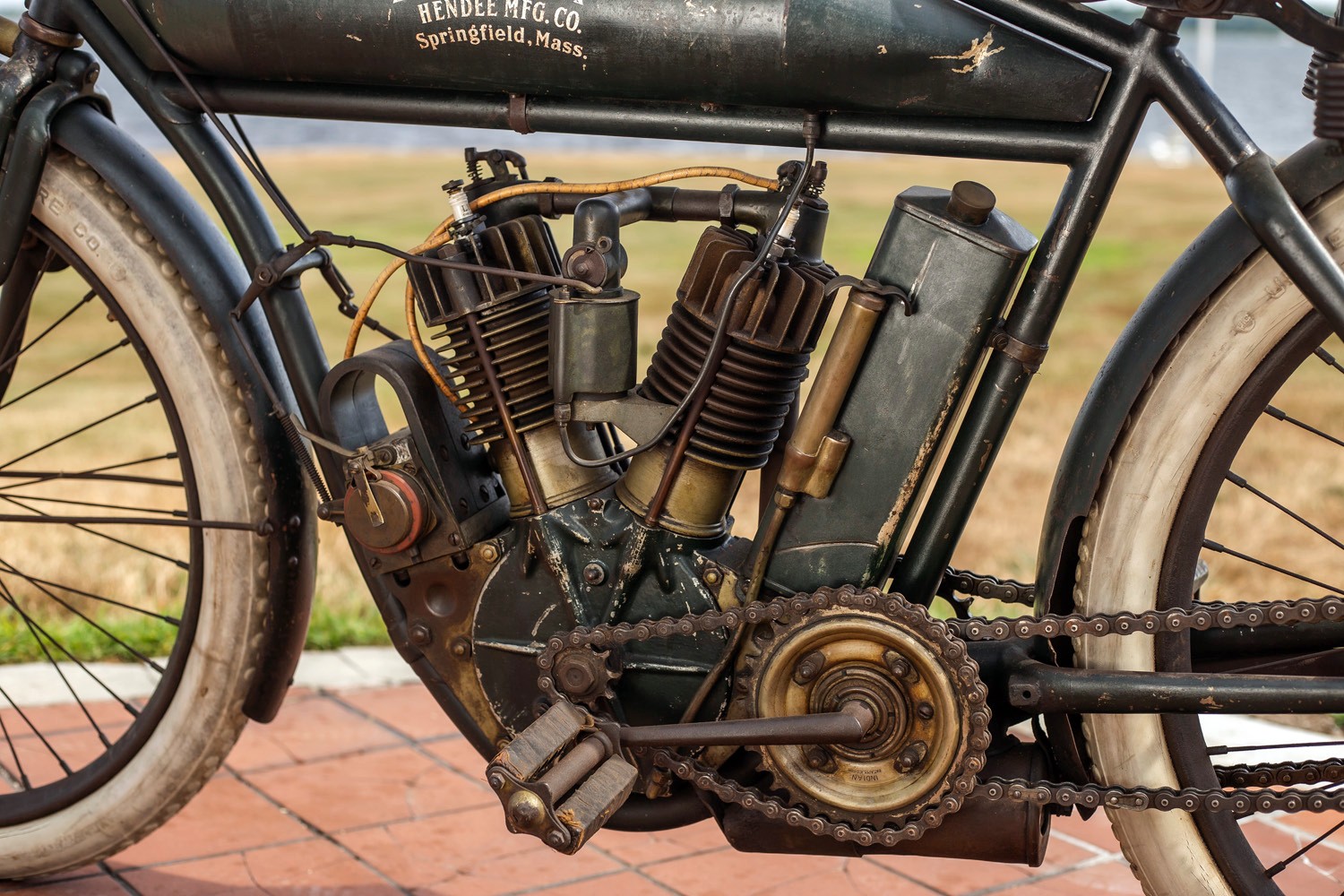
- All-original with very rare factory green paint.
- The first year of the loop frame.
- For sale in complete, operational, and original condition.
- Engine No. 20A352
- HP: 5
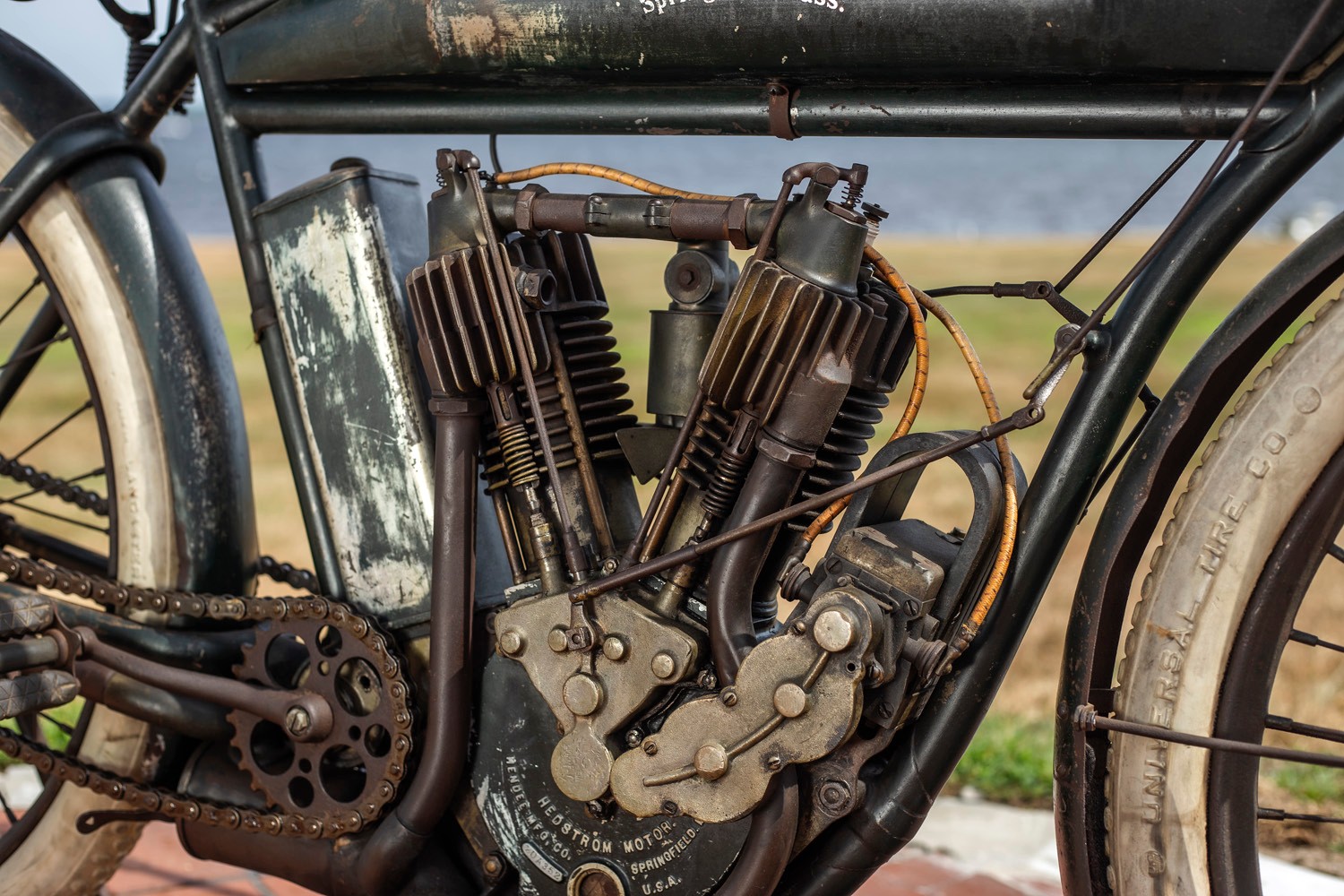
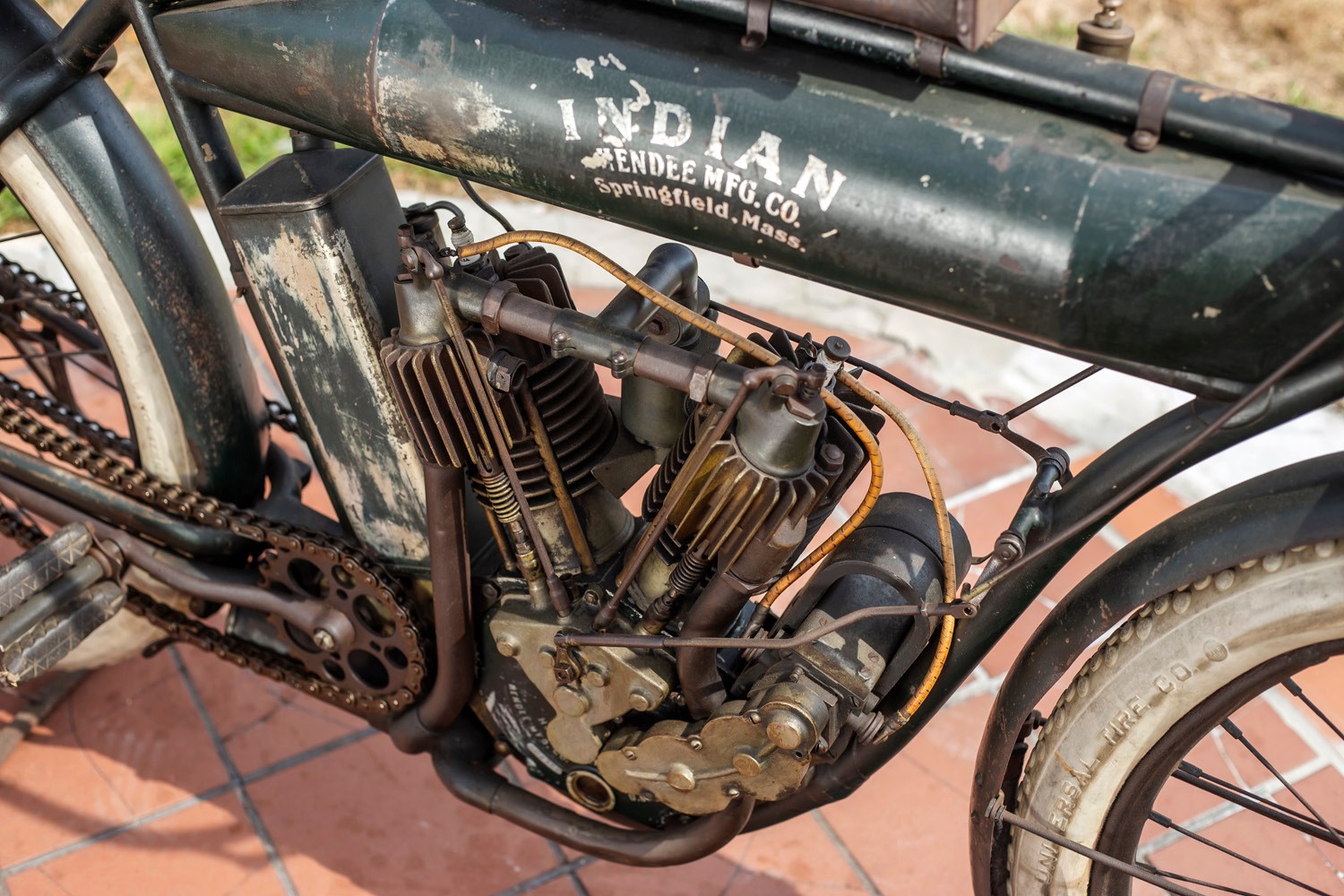
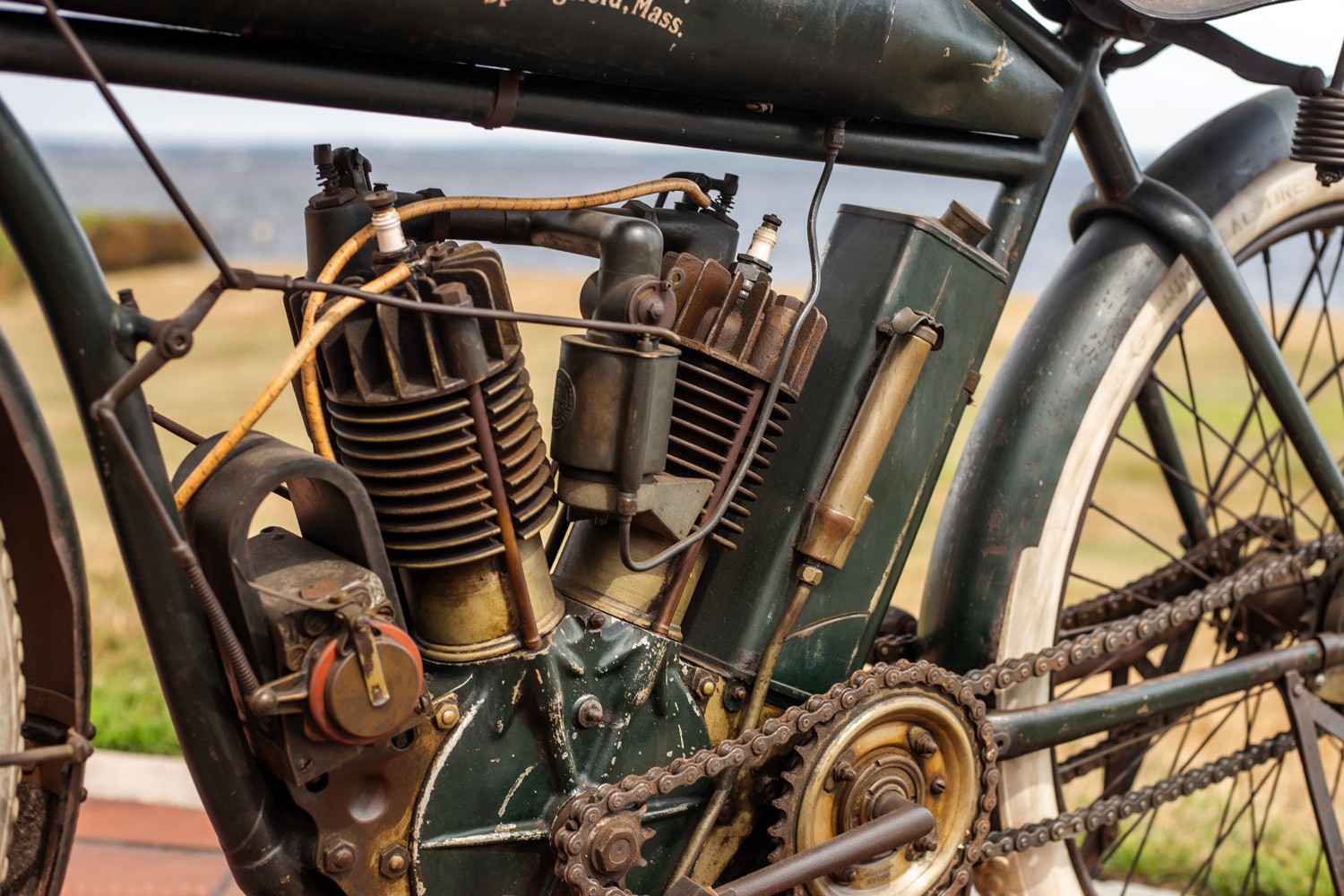
- ENGINE: 38 cu. in. pocket-valve V-twin cylinder
- CARBURETOR: Hedstrom
- TRANSMISSION: Single-Speed, Chain Drive
- FORK: Cartridge Spring
- START: Pedal Start
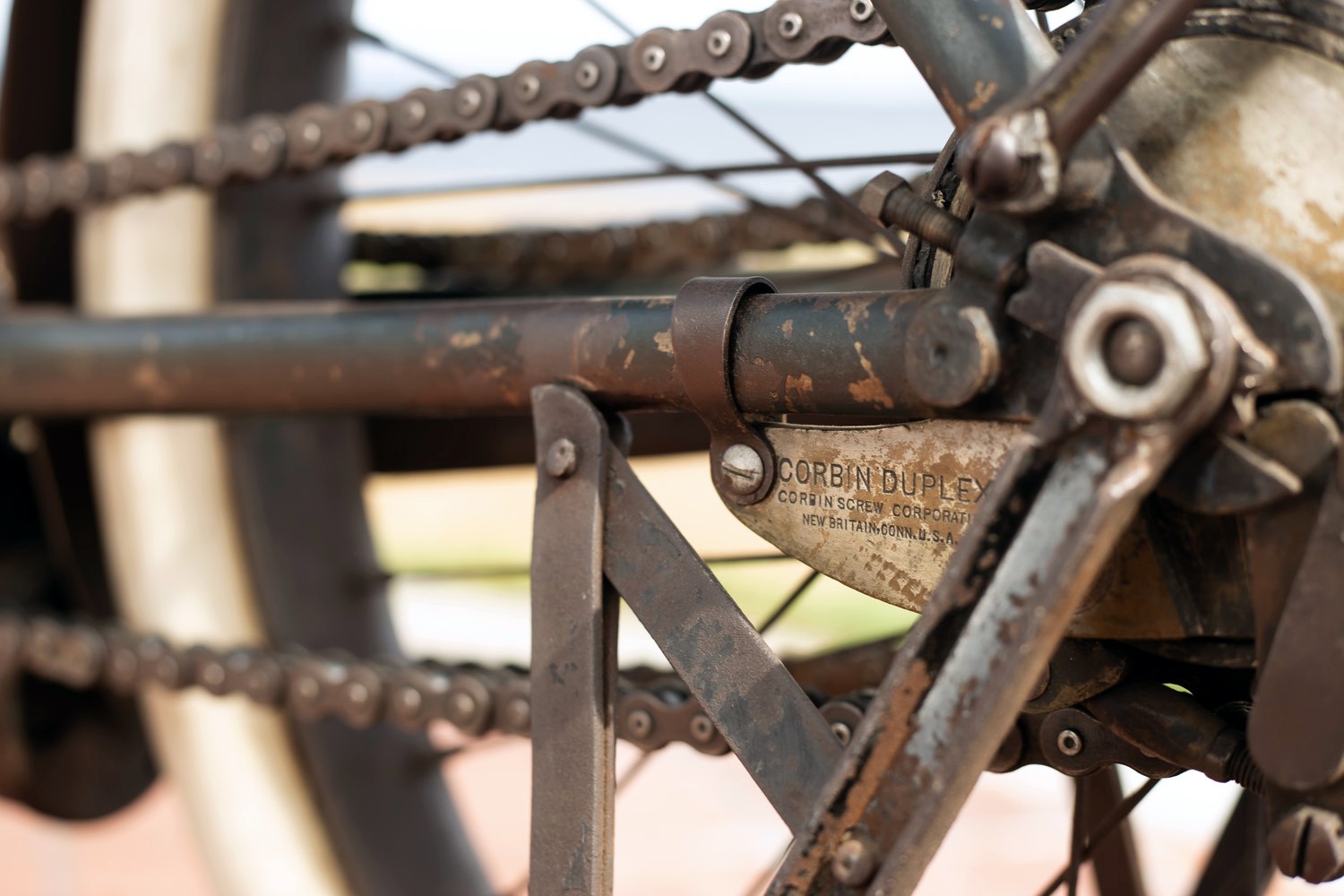
- BRAKE: Rear Band Brake
- WHEELBASE: 52.25 in.
In 1897, George M. Hendee, an accomplished bicycle racer from Massachusetts, founded the Hendee Manufacturing Company to produce bikes. They were initially branded “Silver King” and “Silver Queen” until the name “American Indian” was adopted and then shortened to “Indian” in 1898. In 1900, Hendee teamed up with Oscar Hedstrom from Sweden to develop single-cylinder Motorcycle prototypes in Middletown, Connecticut. Together, they opened the first factory in Springfield, Massachusetts in 1901 to create the first American Motorcycle company where they would be produced until 1953. They hired the Aurora Automatic Machinery Company to manufacture their engines in 1901, which they did under license until 1907 when they would go on to produce Thor Motorcycles.
The first Indian motorcycles with chain drives were sold to the public in 1902 and the pair would go on to produce powerful and reliable vehicles. Hedstrom, a successful racer, broke a new world speed record of 56 mph in 1903 in the company’s first reliability trial and won an endurance race from NYC to Springfield and back. 1904 would bring the introduction of the signature deep red color and, in 1905, Indian’s first V-twin factory racer. Their reliability and ingenuity would make them the largest motorcycle manufacturer in the world by 1910, taking the first three places at the 1911 Isle of Man.
In 1913, Indian began supplying the U.S. Army and they turned the majority of their production efforts from 1917 to 1919 to World War I, most models being based on the PowerPlus. In 1914, Erwin “Cannon Ball” Baker set a record riding from San Diego to the East Coast on a PowerPlus. He would go on to ride a 1916 61ci (1000cc) 42-degree V-twin PowerPlus, which became a highly successful roadster and racing bike, remaining in production with few changes until 1924. In 1923, the company changed its name to the Indian Motocycle Company without an ‘r’ in ‘Motorcycle’ and Indian would continue making its mark, including at the first Daytona 200 in 1937 with a Sport Scout. Indian turned yet again to war production from 1940 to 1945 during WWII and has undergone many changes in name and in location since - from North Carolina, to Minnesota and Iowa, it is now owned and produced by Polaris Industries. Indian motorcycles are still widely known and purchased not just for their rich history and classic American style, but for their modern technology, craftsmanship, powerful engines, their comfortable touring models and cruisers, and their distinctive sound.
“A Little History” From the Audrain Automobile Museum
“This 1909 Indian Twin, aside from the tires, is unrestored and with all original parts, including Indian’s reliable four-horsepower, two-cylinder engine and factory-original green paint. One might initially think of this as a motorized bicycle, but in fact, it is considered a motorcycle, with the pedal cranks only used to help jump-start the engine.
The “Indian Motorcycle Co.” was originally founded as the Hendee Manufacturing Company by George M. Hendee of Springfield, Massachusetts, in 1897 to manufacture bicycles, later branded as “Indian” from 1898 onwards as it gave better product recognition in export markets.
With the addition of Carl Oscar Hedström in 1900, the company designed a motorcycle with a 1.75 bhp single-cylinder engine, and the first Indian motorcycles were sold to the public in 1902. In 1904, the company introduced the deep red color that would become Indian’s trademark.
The Design
In 1909, Indian Motorcycle pioneered the “loop frame” that was more similar to racing motorcycle design than the previous “diamond frame” that originated with bicycles. Indian also introduced several advancements on its 1910 models, including a leaf-spring front fork and an automatic oil pump. Some models also had a two-speed transmission, floorboards, starter hand cranks, and the Indian Motorcycle script logo.
Did You Know?
One of Indian’s most famed riders was Erwin “Cannonball” Baker, who set numerous long-distance records. In 1914, he rode an Indian across the United States, from San Diego to New York, in a record 11 days, 12 hours, and 10 minutes.”
“1909 Indian 5 HP Light Twin” From RM Sotheby’s
“During the first decade of America’s fast-growing motorcycle industry’s existence, Indian swiftly emerged at the forefront as one of the more prominent makes. The company’s participation in various sporting events rewarded them with valuable publicity, which, in turn, popularized their machines to the masses beyond the capabilities of production.
These first years saw the production motorcycle develop from no more than a motor-driven bicycle to a rugged, reliable means of transportation. Progress was rampant, and the company’s racing endeavors continued to fuel its advancement.
By 1909, the Indian lineup was entirely redesigned. The bicycle-inspired diamond frame was replaced with the more conventional loop frame, which had previously been fitted to the racing machines of the company’s top riders. A new, streamlined torpedo-type gas tank was fitted between the upper and lower tank rails, and oil was carried in a large-capacity half-gallon tank that was fixed to the frame beneath the seat. In addition to the improved 2.75-horsepower, single-cylinder model, two new twins were offered: the five-horsepower, 38-cubic-inch Light Twin and the sturdy seven-horsepower, 61-cubic-inch Big Twin. Mechanical intake valves were also now standard equipment on all models.
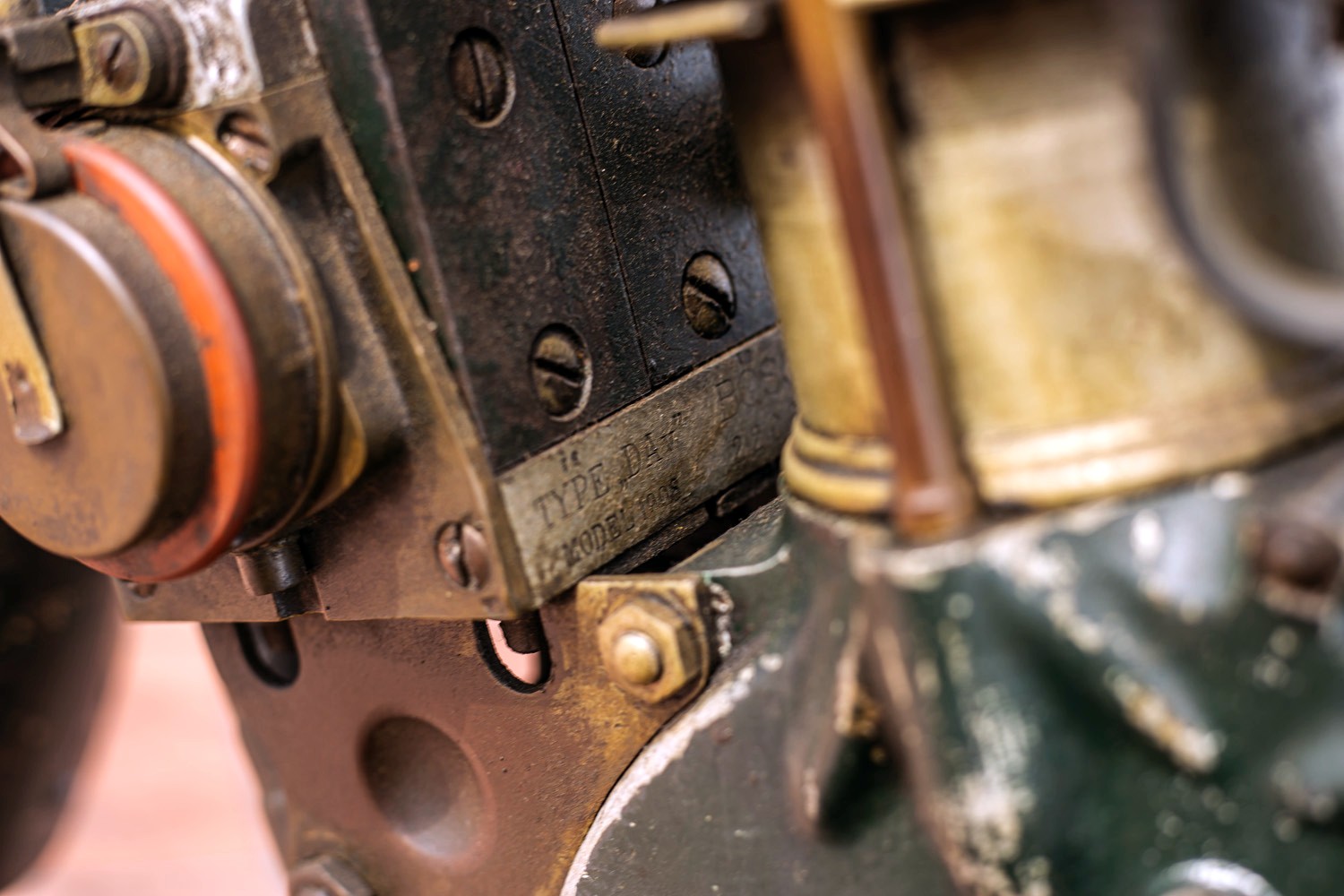
This rare 1909 Indian Twin, formerly of the Jim Atchley Collection, is preserved in unrestored, original condition, and it still retains its unusual green factory paint. The machine features the five-horsepower, 38-cubic-inch, twin-cylinder, pocket-valve engine and its original Hedstrom carburetor and Bosch magneto. Other high-wear items, such as the seat, pedals, and grips, are also original to this machine. This remarkably preserved bike is among the earliest original twin-cylinder Indian motorcycles in existence.”